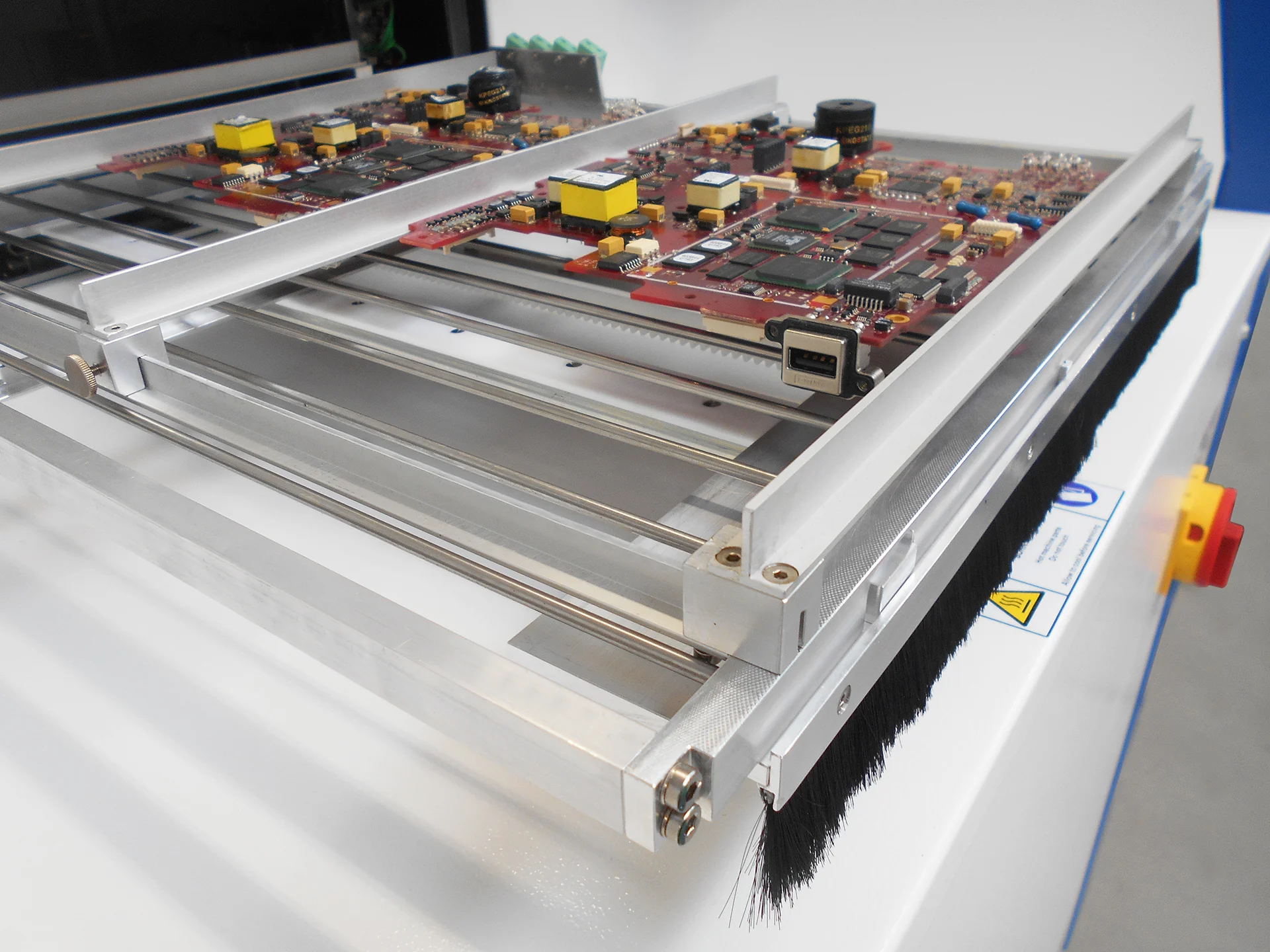
Precise temperature control during vapour phase soldering without overheating
One of the greatest advantages of vapour phase soldering is the precise temperature control. Heat is transferred through the condensation of a medium with a defined boiling temperature. This physically prevents the assembly from overheating.
The result:
Sensitive components are reliably protected against thermal damage, while at the same time the required process energy is precisely applied.
Uniform heating of complex assemblies using vapour phase soldering
A key advantage of vapour phase soldering is the homogeneous heat distribution across the entire assembly. In contrast to convective processes, it does not matter whether components have different sizes, shapes or thermal masses. The heat is transferred evenly, which significantly reduces typical problems.
These include in particular:
- Thermal stresses within the assembly
- Warpage of printed circuit boards
- Soldering faults such as tombstoning or cold solder joints
Oxidation-free process in vapour phase soldering for better soldering quality
Vapour phase soldering creates an almost oxygen-free process environment. The dense vapour displaces oxygen from the process chamber, effectively preventing oxidation.
Why is this important?
Oxidation can significantly impair the quality of soldered joints. The low-oxygen environment significantly improves the wettability of the solder.
This leads to:
- More stable solder connections
- Improved wetting of the solder
- Higher long-term reliability of electronic assemblies
High process reliability and reproducibility in vapour phase soldering
Another decisive advantage of vapour phase soldering is the high reproducibility of the process.
As the physical properties of the medium determine the temperature profile, extremely stable and repeatable process conditions are created. This reduces fluctuations and ensures consistently high quality.
This is particularly relevant for:
- Complex assemblies
- High-mass PCBs
- Safety-critical applications
Consistent process quality is particularly crucial here.
Vapour phase soldering and lead-free solders
Lead-free solders require higher processing temperatures, which poses challenges for many soldering processes.
The vapour phase soldering process makes it possible to reach these temperatures in a controlled and gentle manner without endangering sensitive components. This makes the process ideal for modern, environmentally friendly production processes.
Energy efficiency of vapour phase soldering compared to reflow systems
In addition to process quality, energy efficiency also plays an important role. Compared to convective reflow systems, vapour phase soldering requires less energy.
The reason for this is the direct heat transfer through condensation. No complex zone heating is required, which makes the entire process more efficient.
This reduces:
- Operating costs
- Energy consumption
- Thermal load on the systems
Learn more about the advantages of our vapour phase soldering systems:
Typical areas of application for vapour phase soldering in industry
Due to its technical advantages, vapour phase soldering is mainly used in demanding industries.
Typical fields of application are:
- Aerospace
- Medical technology
- Defense technology
- Prototype construction and small series production
In these areas, maximum reliability and stable processes are crucial for the quality of the products.
Find out more about the applications of vapour phase soldering here: