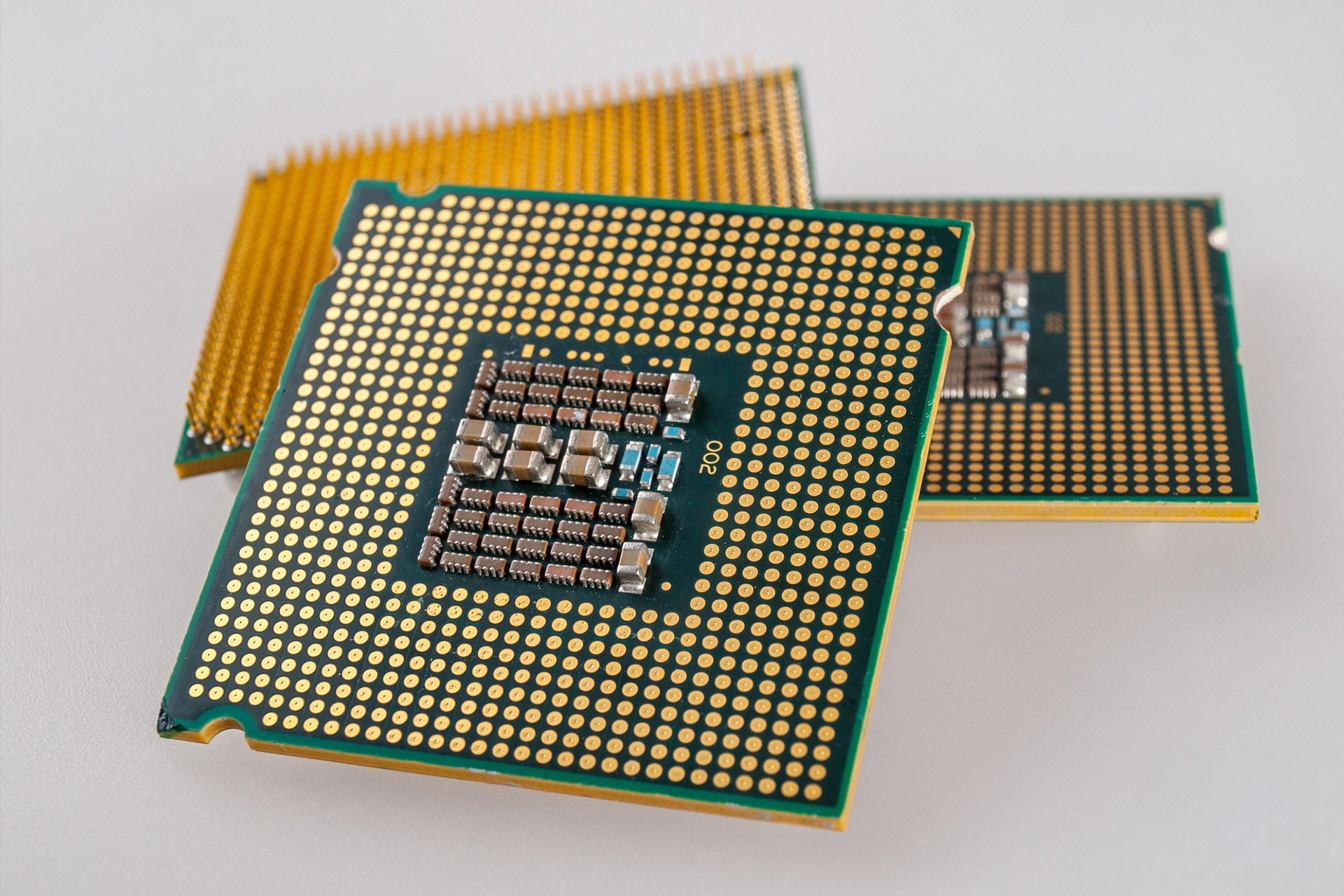
Vapour-phase soldering can be used to process nearly all electronic components used on printed circuit boards in electronics manufacturing. The process is independent of component shape, size, or thermal mass and is particularly well-suited for complex assemblies containing a wide variety of components.
Vapour-phase soldering in electronics manufacturing: suitable components
In modern electronics manufacturing, vapour-phase soldering is used for a wide variety of components.
Both standard SMD components and complex component designs can be processed, including:
- resistors, capacitors, and diodes
- transistors and integrated circuits (ICs)
- BGA packages and other modern packages
Because of the uniform heating, this process is particularly well-suited for applications in which high process reliability is required.
Power devices and high-mass components on printed circuit boards
A particular advantage of vapour-phase soldering is its ability to process components with high thermal mass.
These include, among other things:
- large connectors
- coils and transformers
- heat sink
- power semiconductors
These components pose a challenge in many soldering processes. Due to the uniform heat transfer, however, they can be processed reliably and consistently using vapour-phase soldering.
Learn more about how vapour-phase soldering works and the benefits of this process for consistent and reliable heat transfer in a wide variety of assemblies.
Soldering fine-pitch components and sensitive parts safely
Even delicate components benefit from the properties of this process.
Fine-pitch components with very narrow pin spacing, as well as sensitive components such as:
- sensors
- optical components
can be soldered safely. The even temperature distribution prevents localized overheating and protects sensitive structures.
Mixed-component assembly on printed circuit boards using vapour-phase soldering
In many applications, different types of components are combined on a single assembly.
Vapour-phase soldering is ideal for mixed-component assemblies in which:
- large and heavy components
- along with small microcomponents
are processed. The uniform heating ensures that all components are soldered optimally, regardless of their thermal mass.
HDI circuit boards and modern assemblies in electronics manufacturing
Modern printed circuit boards, such as high-density interconnects (HDI) or multilayer assemblies, place high demands on the soldering process.
Vapour-phase soldering offers clear advantages in this regard:
- even heat distribution without hot spots
- reliable processing of complex structures
- reduced thermal load
System-in-Package modules also benefit from these features.
Avoiding common soldering defects in vapour-phase soldering
The uniform heat distribution significantly reduces typical errors in soldering techniques.
These include:
- tombstoning
- cold joints (cold solder joints)
- component warpage
The process ensures stable, high-quality solder joints, even for complex assemblies.
These components are suitable for vapour-phase soldering
The combination of uniform heating and a physically limited temperature makes this process particularly versatile.
Vapour-phase soldering enables the reliable assembly of everything from simple SMD components to complex HDI circuit boards and sensitive high-end components. This makes it one of the most flexible technologies in modern electronics manufacturing.
Would you like to learn more about our technologies and solutions, or do you have questions about a specific application? We’d be happy to advise you and help you find the right solution for your needs.